

Updated Dec 02, 2025 Test Engine to Practice Test for CWAP-404 Valid and Updated Dumps
Exam Questions for CWAP-404 Updated Versions With Test Engine
CWNP CWAP-404 Exam Syllabus Topics:
| Topic | Details |
|---|---|
| Topic 1 |
|
| Topic 2 |
|
| Topic 3 |
|
| Topic 4 |
|
| Topic 5 |
|
CWNP CWAP-404 Exam Certification Details:
| Sample Questions | CWNP CWAP-404 Sample Questions |
| Passing Score | 70% |
| Exam Code | CWAP-404 CWAP |
| Exam Registration | PEARSON VUE |
| Number of Questions | 60 |
| Recommended Training | CWAP self-paced training kit, Training Class |
| Exam Price | $275 USD |
NEW QUESTION # 62
The PHY layer provides framing by adding a header to create what type of data unit?
- A. PPDU
- B. MSDU
- C. PSDU
- D. MPDU
Answer: A
Explanation:
Explanation
The PHY layer provides framing by adding a header to create a PPDU. A PPDU (PHY Protocol Data Unit) is the data unit that is transmitted or received over the wireless medium by the PHY layer. A PPDU consists of a PSDU (PHY Service Data Unit) and a PHY header, which contains information such as modulation, coding, and data rate. The PHY layer adds the PHY header to the PSDU to create a PPDU for transmission, or removes the PHY header from the PPDU to extract the PSDU for reception. The other options are not correct, as they are not created by adding a header at the PHY layer. An MPDU (MAC Protocol Data Unit) is created by adding a MAC header and FCS to an MSDU (MAC Service Data Unit) at the MAC layer. An MSDU is the data unit that is passed from the LLC sublayer to the MAC sublayer or vice versa. References: [Wireless Analysis Professional Study Guide CWAP-404], Chapter 4: 802.11 Physical Layer, page 97-98
NEW QUESTION # 63
After examining a Beacon frame decode you see the SSID Element has a length of 0. What do you conclude about this frame?
- A. The frame is corrupted
- B. The beacon is from a BSS configured to hide the SSID
- C. This is a common attack on WISP backend SQL databases
- D. SSID elements always have a length of 0
Answer: B
Explanation:
Explanation
If the SSID element has a length of 0 in a Beacon frame decode, it means that the beacon is from a BSS configured to hide the SSID. The SSID element is a part of the Beacon frame that contains the name or identifier of the BSS. The SSID element has two fields: length and value. The length field indicates how many bytes are used for the value field, which contains the actual SSID string. If the length field is 0, it means that there is no value field or SSID string in the element. This is a common technique used by some APs to hide their SSID from passive scanning clients or potential attackers. However, this technique does not provide much security, as there are other ways to discover or reveal the hidden SSID, such as active scanning or capturing probe response or association frames. References: [Wireless Analysis Professional Study Guide CWAP-404], Chapter 5: 802.11 MAC Sublayer, page 122-123
NEW QUESTION # 64
As it relates to a spectrum analyzer, complete the following sentence.
The ____________ plot always displays the percentage of time (shown on the Y axis) that the overall RF power is a certain specified threshold (of amplitude) above the noise floor for a given frequency range (shown on the X axis).
- A. Interferer Count
- B. Real-Time FFT
- C. Swept Spectrogram
- D. SNR
- E. FFT Duty Cycle
Answer: E
NEW QUESTION # 65
In what scenario is Open Authentication without encryption not allowed based on the 802.11 standard?
- A. When operating a BS5 in the CBRS band
- B. When operating a BSS in FIPS mode
- C. When operating a BSS in the 6 GHz band
- D. When operating a BSS in a government facility
Answer: C
Explanation:
Explanation
Open Authentication without encryption is not allowed when operating a BSS in the 6 GHz band, according to the 802.11 standard. Open Authentication is a type of authentication method that does not require any credentials or security information from a STA (station) to join a BSS (Basic Service Set). Open Authentication can be used with or without encryption, depending on the configuration of the BSS and the STA. Encryption is a technique that scrambles the data frames using an algorithm and a key to prevent unauthorized access or eavesdropping. However, in the 6 GHz band, which is a newly available frequency band for WLANs, OpenAuthentication without encryption is prohibited by the 802.11 standard, as it poses security and interference risks for other users and services in the band. The 6 GHz band requires all WLANs to use WPA3-Personal or WPA3-Enterprise encryption methods, which are more secure and robust than previous encryption methods such as WPA2 or WEP. The other options are not correct, as they do not describe scenarios where Open Authentication without encryption is not allowed by the 802.11 standard. When operating a BSS in the CBRS band, which is another newly available frequency band for WLANs, Open Authentication without encryption is allowed, but not recommended, as it also poses security and interference risks for other users and services in the band. When operating a BSS in FIPS mode, which is a mode that complies with the Federal Information Processing Standards for cryptographic security, Open Authentication without encryption is allowed, but not compliant, as it does not meet the FIPS requirements for encryption algorithms and keys. When operating a BSS in a government facility, Open Authentication without encryption is allowed, but not advisable, as it may violate the government policies or regulations for wireless security. References: [Wireless Analysis Professional Study Guide CWAP-404], Chapter 8: Security Analysis, page 220-221
NEW QUESTION # 66
The To DS bit is set to 0 and the From DS is set to 1.
What best describes this 802.11 frame?
- A. A frame being transmitted directly from one client STA to another
- B. A frame being transmitted from a client STA to an AP
- C. A frame being transmitted in a mesh BSS
- D. A frame being transmitted from an AP to a client STA
Answer: D
NEW QUESTION # 67
What is used to respond with an uplink transmission to an MU-RTS trigger frame in the 802.11ax PHY?
- A. HE SU PPDU
- B. HE TB PPDU
- C. HE MU PPDU
- D. VHT PPDU
Answer: B
Explanation:
An HE TB PPDU (High Efficiency Trigger-Based Packet Data Unit) is used to respond with an uplink transmission to an MU-RTS trigger frame in the 802.11ax PHY (Physical Layer). An MU- RTS trigger frame is a frame that initiates a multi-user transmission opportunity (MU-TXOP) by requesting multiple stations (STAs) to send clear-to-send (CTS) frames on different spatial streams or resource units (RUs). An HE TB PPDU is a frame that contains data from multiple STAs that have been allocated RUs by an MU-RTS trigger frame or another type of trigger frame.
An HE SU PPDU (High Efficiency Single User Packet Data Unit) is a frame that contains data from a single STA using all available spatial streams or RUs. An HE MU PPDU (High Efficiency Multi User Packet Data Unit) is a frame that contains data from multiple STAs using different spatial streams or RUs without being triggered by another frame. A VHT PPDU (Very High Throughput Packet Data Unit) is a frame that uses the 802.11ac PHY and does not support multi- user transmissions.
NEW QUESTION # 68
You are considering the performance of a BSS based on different PHY types used. In the BSS, one device must use ERP as it does not support HT in its 2.4 GHz band.
What is the duration of the interframe space for this ERP device for standard data frame transmissions?
- A. 28 microseconds
- B. 16 microseconds
- C. 10 microseconds
- D. 9 microseconds
Answer: A
NEW QUESTION # 69
As shown in the exhibit, a spectrum analyzer has measured both 802.11 and non-802.11 RF transmissions in the 2.4 GHz band. The exhibit shows a continuous video transmitter near channel 5.
Based upon the exhibit, what impact does the video transmitter have on WLAN operations throughout the band?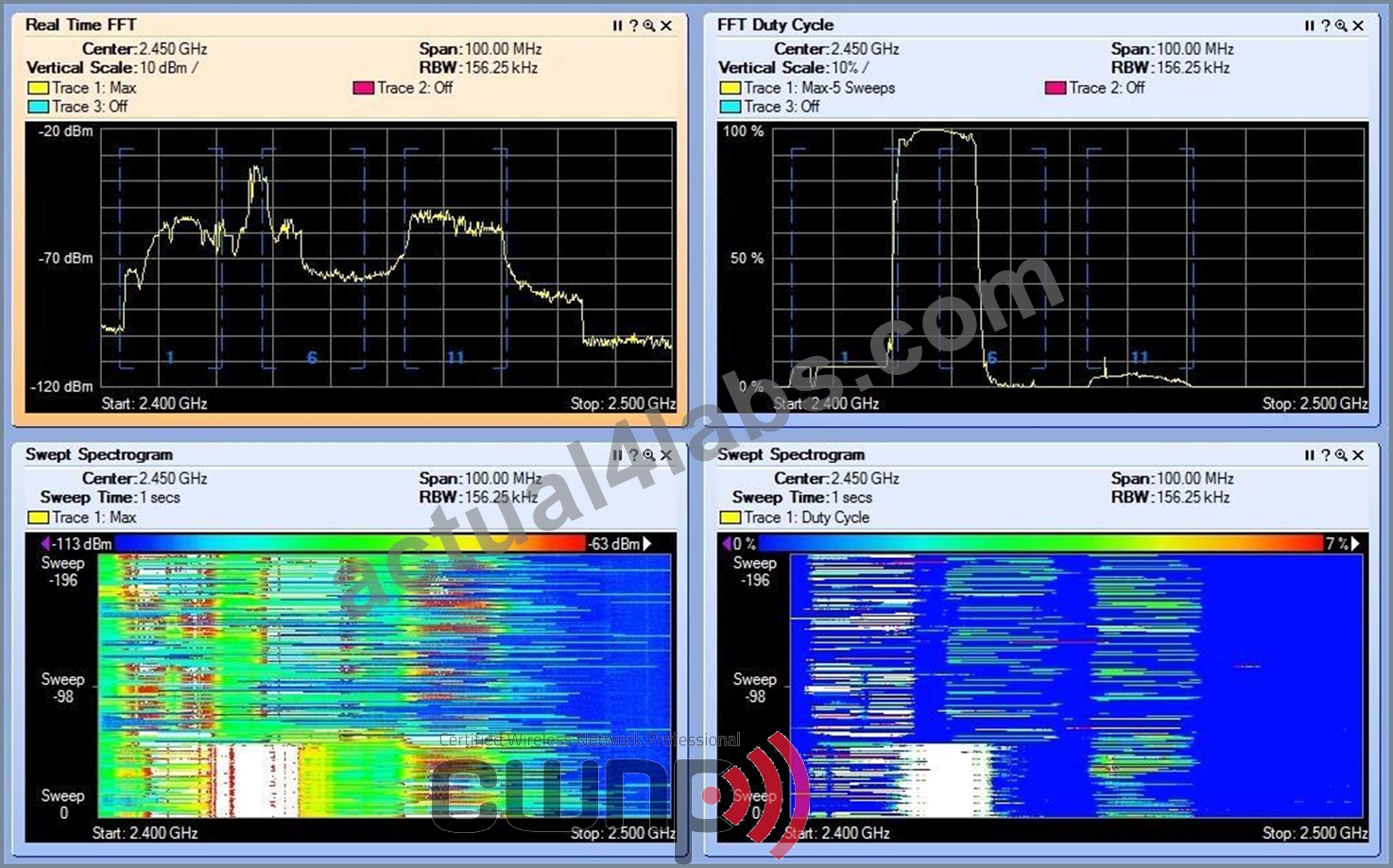
- A. The video transmitter is preventing WLAN operation on channel 6, and has only a minor impact on channels 1 and 11.
- B. The video transmitter has made no impact on WLAN operation in the band.
- C. The video transmitter is preventing all WLAN transmissions in the band.
- D. The video transmitter is preventing all WLAN transmissions on channel 6, and its impact on channels 1 and 11 is severe.
Answer: A
NEW QUESTION # 70
You are performing a multiple adapter channel aggregation capture to troubleshoot a VoIP roaming problem and would like to measure the roaming time from the last VoIP packet sent on the old AP's channel to the first VoIP packet sent on the new AP's channel. Which timing column in the packet view would measure this for you?
- A. Relative
- B. Delta
- C. Absolute
- D. Roaming
Answer: D
Explanation:
The "Roaming" timing column specifically measures the time elapsed between the last packet on the old AP's channel and the first packet on the new AP's channel, providing valuable information about the roaming time in VoIP troubleshooting scenarios.
NEW QUESTION # 71
In an HT WLAN in which a delayed Block Ack policy is set up, what should result when an ACK frame is not received by the originator in response to a Basic BlockAckReq?
- A. All frames within that block must be retransmitted by the originator.
- B. The BlockAckReq must be retransmitted by the originator.
- C. The last frame within that block must be retransmitted by the originator.
- D. Nothing. No ACK is expected in response to a Basic BlockAckReq.
Answer: B
NEW QUESTION # 72
As the WLAN administrator in your organization you are responsible for troubleshooting connection issues. Several STAs are connecting to the network, but are unable to communicate after connection. You suspect a DHCP problem. After capturing traffic on the wired-side of the AP, you want to view only DHCP traffic. What filter in Wireshark can be used for this purpose?
- A. DHCPv6
- B. DHCP
- C. BOOTP
- D. DHCPv4
Answer: B
NEW QUESTION # 73
What is the default 802.11 authentication method for a STA when using Pre-RSNA?
- A. Shared Key
- B. PSK
- C. Open System
- D. 4-Way Handshake
Answer: C
Explanation:
The default 802.11 authentication method for a STA when using Pre-RSNA is Open System. This is the simplest and most common authentication method, which does not provide any security or encryption. In Open System authentication, the STA sends an Authentication Request frame to the AP, and the AP responds with an Authentication Response frame with a status code of success. After this, the STA can proceed to association with the AP.
NEW QUESTION # 74
What is indicated to a QoS AP when a QoS STA sets U-APSD Flag bits to 1 in (Re) Association frames?
- A. Which access categories are both trigger-enabled and delivery-enabled
- B. Which user priorities require use of a TSPEC
- C. Which access categories are scheduled
- D. Which user priorities are mapped to access categories
- E. Which access categories require admission control
Answer: A
NEW QUESTION # 75
You have been recently hired as the wireless network administrator for an organization spread across seven locations. They have deployed more than 100 APs, but they have not been managed in either an automated or manual process for more than 18 months.
Given this length of time, what is one of the first things you should evaluate from a support perspective?
- A. The VLANs in use
- B. The data rates allowed
- C. The channels in use
- D. The firmware revision
Answer: D
NEW QUESTION # 76
Where, in a protocol analyzer, would you find an indication that a frame was transmitted as part of an A-MPDU?
- A. A-MPDU flag in the QoS Control Field
- B. A-MPDU flag in the Frame Control Field
- C. The Aggregation flag in the Radio Tap Header
- D. The HT Operation Element
Answer: C
Explanation:
Explanation
In a protocol analyzer, you would find an indication that a frame was transmitted as part of an A-MPDU by looking at the Aggregation flag in the Radio Tap Header. The Radio Tap Header is a pseudo-header that is added by some wireless capture devices to provide additional information about the physical layer characteristics of a frame. The Aggregation flag is one of the fields in this header, and it indicates whether the frame belongs to an A-MPDU or not. If the flag is set to 1, it means that the frame is part of an A-MPDU; if it is set to 0, it means that the frame is not part of an A-MPDU . References: CWAP-404 Certified Wireless Analysis Professional Study and Reference Guide, Chapter 9: PHY Layer Frame Formats andTechnologies, page 303; CWAP-404 Certified Wireless Analysis Professional Study and Reference Guide, Chapter 9: PHY Layer Frame Formats and Technologies, page 304.
NEW QUESTION # 77
Using a portable analyzer you perform a packet capture next to a client STA and you can see that the STA is associated to a BSS. You observe the STA sending packets to the AP and the AP sending packets to the STA. Less the 2% of all packets are retransmissions. You move to capture packets by the AP and, while the retry rate is still very low, you now only see unidirectional traffic from the AP to the client. How do you explain this behavior?
- A. The STA is transmitting data using more spatial streams than the potable analyzer can support
- B. There is a transmit power mismatch between the client and the AP and while the client can hear the Aps traffic, the AP cannot hear the client.
- C. The portable analyzer is too close to the AP causing CCI, blinding the AP to the client's packets
- D. The portable analyzer has a lower receive sensitivity than the AP and while it can't capture the packets from the client STA, the AP can receive them OK.
Answer: D
Explanation:
Receive sensitivity is the minimum signal level that a receiver can detect and decode. Different devices may have different receive sensitivity levels depending on their hardware specifications and antenna configurations. In this scenario, the portable analyzer has a lower receive sensitivity than the AP, meaning that it requires a stronger signal to capture the packets from the client STA.
The AP, on the other hand, has a higher receive sensitivity and can receive the packets from the client STA even if they have a weaker signal. This explains why the portable analyzer can only see unidirectional traffic from the AP to the client when capturing near the AP.
NEW QUESTION # 78
As it pertains to HT L-SIG TXOP Protection, what statement is true?
- A. Support for L-SIG TXOP Protection is indicated by HT stations in the L-SIG field of the PLCP header of HT-mixed format frames.
- B. Support for L-SIG TXOP Protection is indicated in the HT Capabilities Info field of (re)association request frames sent by ERP, OFDM, and HT-OFDM stations.
- C. L-SIG TXOP Protection is specified for the purpose of protecting OFDM (802.11a/g) and HT- OFDM (802.11n) transmissions from HR/DSSS stations.
- D. An L-SIG TXOP protected frame exchange sequence always begins with an RTS/CTS or a CTS- to-Self.
Answer: D
NEW QUESTION # 79
Where, in a protocol analyzer, would you find an indication that a frame was transmitted as part of an AMPDU?
- A. A-MPDU flag in the Frame Control Field
- B. The Aggregation flag in the Radio Tap Header
- C. A-MPDU flag in the HT Control Field
- D. The HT Operation Element
Answer: B
Explanation:
In a protocol analyzer, you would find an indication that a frame was transmitted as part of an A- MPDU by looking at the Aggregation flag in the Radio Tap Header. The Radio Tap Header is a pseudo- header that is added by some wireless capture devices to provide additional information about the physical layer characteristics of a frame. The Aggregation flag is one of the fields in this header, and it indicates whether the frame belongs to an A-MPDU or not. If the flag is set to 1, it means that the frame is part of an A-MPDU; if it is set to 0, it means that the frame is not part of an A-MPDU.
NEW QUESTION # 80
When performing protocol analysis, you notice a high number of RTS/CTS frames being transmitted on an HT network. You suspect this may be due to HT protection mechanisms. Where in the Beacon frame would you look to determine which one of the four HT protection modes the AP is operating in?
- A. HT Operation Element
- B. HT Information Element
- C. Non-HT Present Element
- D. HT Protection Element
Answer: B
Explanation:
Explanation
When performing protocol analysis, you would look at the HT Information Element in the Beacon frame to determine which one of the four HT protection modes the AP is operating in. The HT Information Element contains various subfields that provide information about the HT network configuration and operation. One of these subfields is the HT Protection field, which indicates whether any protection mechanisms are required for mixed-mode operation with non-HT STAs. The four possible values for this field are:
No Protection: No protection mechanisms are required.
Non-member Protection: RTS/CTS or CTS-to-self protection is required for all HT transmissions.
20 MHz Protection: RTS/CTS or CTS-to-self protection is required for all HT transmissions using a 40 MHz channel.
Non-HT Mixed Mode: All HT transmissions must use a non-HT preamble and header . References:
CWAP-404 Certified Wireless Analysis Professional Study and Reference Guide, Chapter 11:
802.11n/ac/ax PHYsical Layer Frame Exchanges, page 378; CWAP-404 Certified Wireless Analysis Professional Study and Reference Guide, Chapter 11: 802.11n/ac/ax PHYsical Layer Frame Exchanges, page 379.
NEW QUESTION # 81
A PHY Header is added to the PSDU at which sub-layer?
- A. PHY
- B. MAC
- C. Network
- D. LLC
Answer: A
Explanation:
A PHY header is added to the PSDU at the PHY layer. A PHY header is a part of the PPDU that contains information such as modulation, coding, and data rate. The PHY header is added by the PHY layer when it converts a PSDU to a PPDU for transmission, or removed by the PHY layer when it converts a PPDU to a PSDU for reception. The other layers do not add or remove a PHY header.
NEW QUESTION # 82
Given: Shown are frames captured from an IEEE 802.1X/LEAP authentication.
This WLAN is a Robust Security Network (RSN) using the CCMP cipher suite.
Using the information given in the screenshot, calculate how long it takes for only the frames that are part of the 4-Way handshake to complete.
- A. 210.443 ms
- B. 243.743 ms
- C. 237.753 ms
- D. 3.018 ms
- E. 5.820 ms
Answer: E
NEW QUESTION # 83
When a 5 GHz HT station in a 40 MHz BSS desires to protect a 40 MHz transmission from an OFDM station using an RTS/CTS or CTS-to-Self exchange, what frame format is used for the RTS and/or CTS frames?
- A. Dual-CTS
- B. HT-mixed format
- C. HT-greenfield format
- D. Phased Coexistence PPDU
- E. Non-HT Duplicate
Answer: E
NEW QUESTION # 84
While at a government-operated facility, you are attempting to troubleshoot a WLAN performance problem using a wireless protocol analyzer. When you start capturing frames, you see a proprietary layer 2 protocol running over the ERP network as shown in this screenshot. The facility's WLAN administrator confirms that this protocol is proprietary and used for both data encryption and compression.
How will this information affect the steps you take to troubleshoot performance problems on this WLAN?
- A. As long as you load the proprietary software codec onto your analyzer computer, you will be able to see all of the Data frame information fully decoded. Loading the proprietary software codec will allow you to troubleshoot the WLAN as though no encryption were in use.
- B. In order to troubleshoot performance problems on a network using proprietary encryption protocols like this one, you must use a wireless protocol analyzer that has integrated support for the protocol in use.
- C. The proprietary encryption protocol will have no effect on your troubleshooting steps because the wireless protocol analyzer can still decode the PLCP and MAC headers of Data frames. This situation is essentially no different than troubleshooting a WLAN that uses WPA2-Personal.
- D. Troubleshooting will be somewhat limited because only part of the information needed for performance measurements by the analyzer is encrypted. Each Data frame's MAC header will be encrypted, but the PLCP header can still be decoded successfully.
Answer: C
NEW QUESTION # 85
......
CWAP-404 Exam Dumps - Free Demo & 365 Day Updates: https://simplilearn.actual4labs.com/CWNP/CWAP-404-actual-exam-dumps.html